I Ching - Great Invigorating: Great, Ta (T� KWANG)
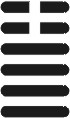
Hexagram Number 34
Keyword(s): Great Power
Symbolic of: great wisdom
THE T� KWANG HEXAGRAM

The General Meaning
T� Kwang indicates that (under the
conditions which it symbolises) it will be advantageous to be firm
and correct.
Explanation of the separate lines
1. The first NINE, undivided, shows its subject manifesting his strength in his toes. But advance will lead to evil,--most certainly.
2. The second NINE, undivided, shows that with firm correctness there will be good fortune.
3. The third NINE, undivided, shows, in the case of a small man, one using all his strength; and in the case of a superior man, one whose rule is not to do so. Even with firm correctness the position would be perilous. (The exercise of strength in it might be compared to the case of) a ram butting against a fence, and getting his horns entangled.
4. The fourth NINE, undivided, shows (a case in which) firm correctness leads to good fortune, and occasion for repentance disappears. (We see) the fence opened without the horns being entangled. The strength is like that in the wheel-spokes of a large wagon.
5. The fifth SIX, divided, shows one who loses his ram(-like strength) in the ease of his position. (But) there will be no occasion for repentance.
6. The sixth SIX, divided, shows (one who may be compared to) the ram butting against the fence, and unable either to retreat, or to advance as he would fain do. There will not be advantage in any respect; but if he realise the difficulty (of his position), there will be good fortune.
 DISCOVER TAROT ON iPHONE, iPAD AND ANDROID.
Learn Tarot Card Meanings, what they mean when combined in a reading, test your knowledge in the Tarot Quiz and reveal what the future may hold with the Tarot Reading App.